
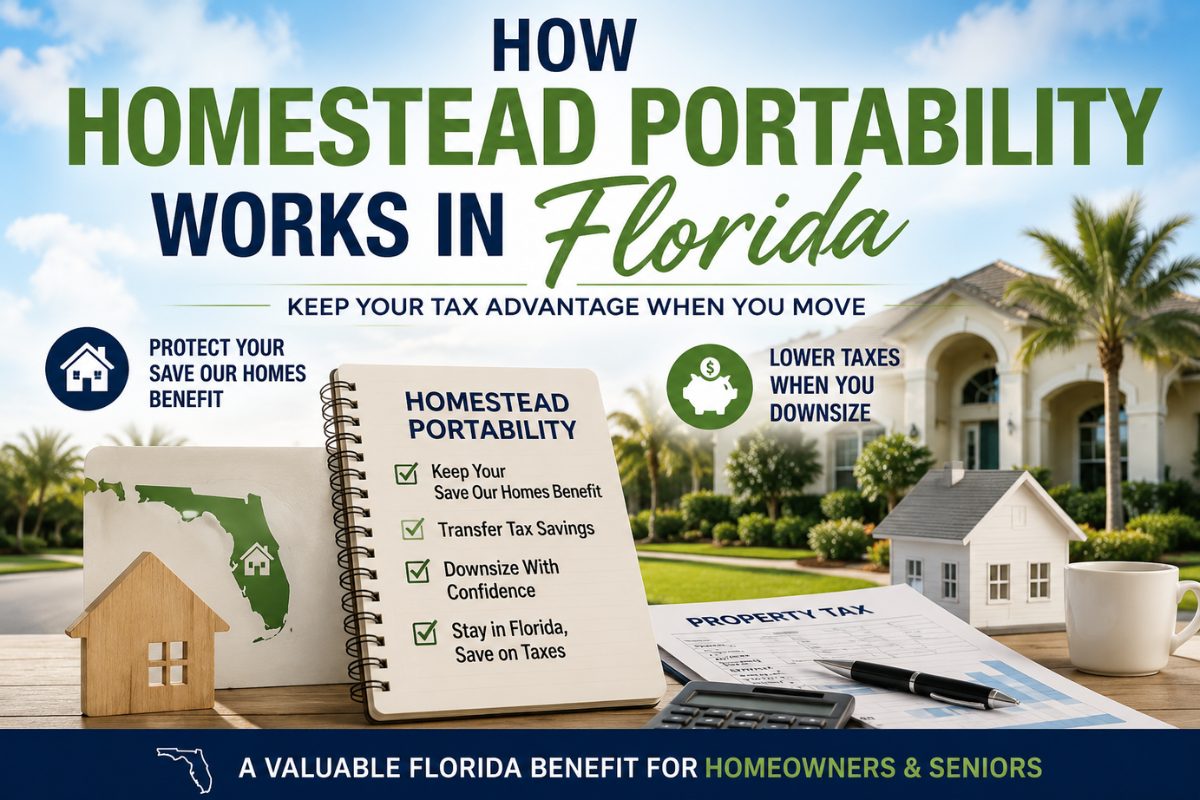
How Homestead Portability Works in Florida
One of the most common things I hear from longtime Florida homeowners is:
“I’d love to move, but my property taxes are so low that I can’t afford to.”
For many homeowners in New Port Richey, Trinity, Spring Hill, and throughout Florida, that concern is understandable.
If you’ve lived in your home for 10, 15, 20, or even 30 years, there’s a good chance your property taxes are significantly lower than what a new buyer would pay for the exact same house.
What many homeowners don’t realize is that they may not have to give up all of that tax advantage when they move.
Thanks to Florida Homestead Portability, many homeowners can transfer a portion of their accumulated tax benefit to another Florida homesteaded property.
For seniors considering downsizing, retirees looking to simplify life, or homeowners wondering whether moving still makes financial sense, understanding portability can be incredibly important.
Why Some Florida Homeowners Pay Much Lower Taxes Than Their Neighbors
To understand Florida Homestead Portability, it helps to first understand Florida’s Save Our Homes protection.
When a homeowner qualifies for Homestead Exemption, the property’s assessed value can generally increase by no more than 3% per year, regardless of how quickly market values rise.
Over time, this creates a growing difference between:
- Market Value
- Assessed Value
Market value is what your home could sell for today.
Assessed value is the value the Property Appraiser uses for tax purposes.
The longer someone owns a homesteaded property, the larger this gap often becomes.
This is why two neighbors with nearly identical homes can pay dramatically different property taxes.
One homeowner may have purchased the property twenty years ago and accumulated substantial Save Our Homes benefits.
The other may have purchased recently and is paying taxes based on a much higher assessed value.
The Problem Many Seniors Face
I often meet homeowners who tell me:
“I’d like to downsize, but my taxes are so low that I don’t think I can afford to move.”
This is especially common among:
- Retirees
- Empty nesters
- Seniors
- Longtime Florida residents
Many of these homeowners are living in homes that no longer fit their needs.
Maybe the house is larger than necessary.
Maybe the pool is becoming expensive to maintain.
Maybe the roof is aging.
Maybe insurance premiums continue to rise.
Maybe the property requires more upkeep than it once did.
Many of these homeowners eventually begin exploring downsizing in Florida, only to discover that portability may make the move more affordable than they expected.
Yet they stay because they assume moving means losing decades of accumulated property tax savings.
In many cases, that assumption isn’t entirely accurate.
What Is Florida Homestead Portability?
Florida Homestead Portability allows eligible homeowners to transfer a portion of their accumulated Save Our Homes benefit from one homesteaded Florida property to another homesteaded Florida property.
In simple terms:
If you’ve built up a substantial tax advantage in your current home, you may be able to take some of that benefit with you when you move.
This can significantly reduce the property tax impact of downsizing or relocating within Florida.
While portability rules are established at the state level, homeowners should always verify their specific situation with their local Property Appraiser’s office because individual circumstances can affect eligibility and calculations.
Example #1: Moving to a More Expensive Home
Let’s look at a simplified example.
Current Home:
- Market Value: $400,000
- Assessed Value: $200,000
In this example, the homeowner has accumulated approximately $200,000 of Save Our Homes benefit.
If that homeowner purchases a replacement home for $500,000, a significant portion of that accumulated benefit may transfer to the new property.
The result could be a much lower taxable value than if they purchased the same home without portability.
This can create meaningful tax savings for years to come.
Example #2: Downsizing to a Less Expensive Home
This is the example many seniors find most interesting.
Current Home:
- Market Value: $400,000
- Assessed Value: $200,000
In this example, the homeowner’s assessed value is approximately 50% of market value.
Now suppose they sell that home and purchase a condominium for $150,000.
Under portability rules, the homeowner may be able to transfer a similar percentage benefit to the replacement property.
Using this simplified example, the new assessed value could potentially be reduced significantly below the purchase price.
This is one reason many homeowners are surprised to discover that downsizing may be more affordable than they originally assumed.
One Important Thing Most Homeowners Don’t Realize
Portability is not automatic.
This is probably the most misunderstood part of the entire process.
Many homeowners assume that because they qualified for Homestead Exemption on their previous property, everything will simply transfer to the new property automatically.
That is not how it works.
Generally speaking, homeowners must:
- Establish Homestead Exemption on the new property
- Apply for portability
- Meet required filing deadlines
- Provide any necessary documentation
If you don’t apply, the benefit does not automatically follow you.
That’s why I encourage homeowners to learn about portability before they move rather than after.
A little planning can help avoid costly surprises.
Why This Matters More Today Than It Did a Few Years Ago
For many Florida homeowners, the decision to stay or move isn’t just about taxes anymore.
Today’s homeowners are also dealing with:
- Rising insurance premiums
- Insurance non-renewal concerns
- Aging roofs
- HVAC replacement costs
- Pool resurfacing expenses
- Property maintenance
- HOA increases
- Inflation
I regularly meet homeowners who are paying relatively low property taxes but are facing significant increases in other ownership costs.
For example, a homeowner may be considering:
- A new roof
- A new air conditioner
- Pool repairs
- Major exterior maintenance
At the same time, they may be living in a home that is larger than they need.
When portability enters the conversation, the financial picture can look very different.
That’s why understanding your options is so important.
Common Myths About Florida Homestead Portability
Myth #1: I’ll Lose My Tax Advantage If I Move
Not necessarily.
Many homeowners may be eligible to transfer a portion of their accumulated Save Our Homes benefit to another Florida homesteaded property.
Myth #2: Portability Is Only For Seniors
No.
While seniors often benefit from portability, eligibility is not limited to retirees.
Myth #3: Portability Happens Automatically
Absolutely not.
You must apply for portability.
It does not automatically transfer when you move.
Myth #4: Property Taxes Are The Only Thing That Matters
Property taxes are important.
But homeowners should also consider:
- Insurance costs
- Maintenance expenses
- Property condition
- Lifestyle needs
- Future plans
Sometimes staying put is the right decision.
Sometimes downsizing makes more sense.
The key is understanding the full picture.
Before You Decide To Stay, Run The Numbers
One thing I’ve learned after working with many homeowners throughout Pasco County and Hernando County is that assumptions can be expensive.
Many homeowners assume:
- They can’t afford to move
- They’ll lose their tax benefit
- Their current home is still their best financial option
But once we start looking at:
- Portability
- Insurance costs
- Maintenance expenses
- Future repairs
- Lifestyle goals
the answer isn’t always what they expected.
That’s why I encourage homeowners to start exploring their options before making assumptions.
In fact, I recently wrote a detailed guide called Should You Sell Your Home Now? that explores many of the insurance, maintenance, tax, and lifestyle factors homeowners should evaluate before making a decision.
You may discover that moving makes more sense than you thought.
Or you may discover that staying put remains the best decision.
Either way, you’ll be making that choice with better information.
Final Thoughts
Florida Homestead Portability is one of the most valuable benefits many homeowners never fully understand.
For longtime Florida residents, it can make a significant difference when considering downsizing, relocating, or moving into a home that better fits their current lifestyle.
I am not a tax professional, and portability calculations can vary depending on individual circumstances.
Homeowners should always verify eligibility requirements, deadlines, and benefit calculations with their local Property Appraiser’s office and qualified tax professionals.
But if you’ve been staying in your current home primarily because you’re worried about losing your low property taxes, it may be worth learning more.
You might have more options than you realize.
And if you’re considering downsizing, retirement, selling an inherited property, or simply wondering whether your current home still makes sense for your future, I encourage you to start the conversation early.
You may also find my article My Home Selling Options Explained helpful if you’re curious about the different levels of support available when selling a home.
Every homeowner’s situation is different, and sometimes the opportunities—or misconceptions—only become obvious once we sit down and look at the entire picture together.




2 Comments
Comments are closed.