
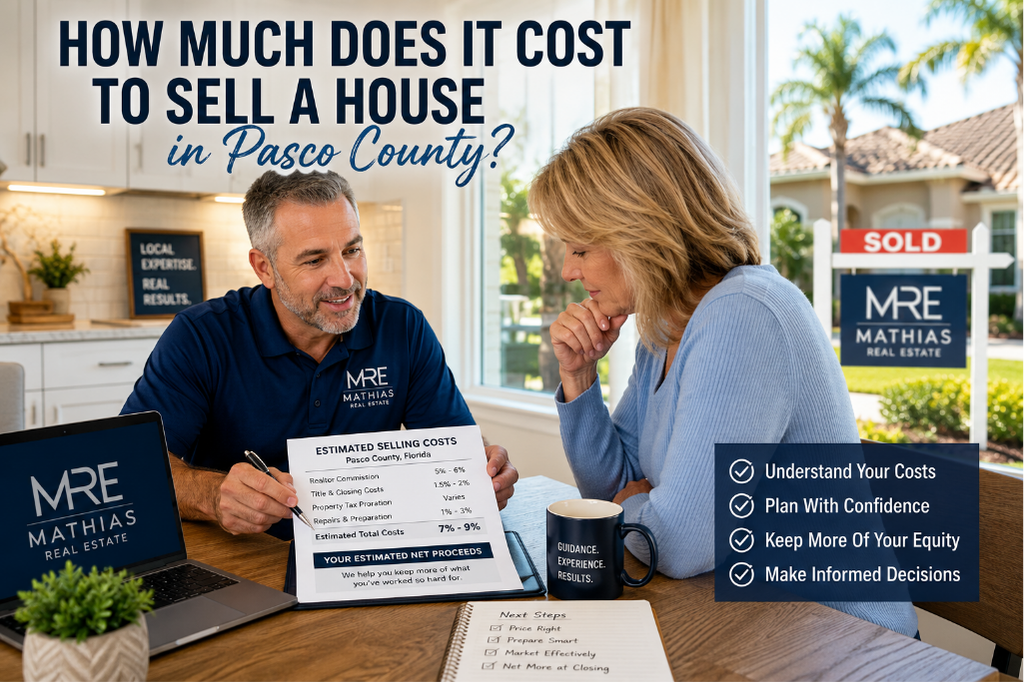
How Much Does It Cost to Sell a House in Pasco County?
Selling a house in Pasco County isn’t just about the sale price. The number that really matters is how much you walk away with after the sale.
Seller expenses can include real estate brokerage compensation, Florida documentary stamp tax, title and closing expenses, mortgage payoff costs, repairs or preparation, negotiated buyer credits, and other transaction-specific items.
Some of those costs are predictable. Others depend on your home, your contract and how you decide to sell. Understanding the difference can help you make a better decision before you put your house on the market.
What does it cost to sell a house in Pasco County?
There isn’t one percentage that applies to every Pasco County home sale. Your total selling cost depends on the compensation you negotiate with your real estate brokerage, the terms of the buyer’s offer, your closing and title arrangements, any repairs or credits, your mortgage payoff and other property-specific expenses.
One cost that can be calculated directly is Florida’s documentary stamp tax on the deed. In Pasco County, the state rate is currently $0.70 for each $100, or portion of $100, of consideration. For example, a $400,000 transaction would generally produce $2,800 in documentary stamp tax on the deed.
Where does the money go when you sell a home?
A seller’s closing statement can contain quite a few line items, but most expenses fall into a handful of categories. The important distinction is that not every seller pays every expense below, and several items are negotiable.
Real Estate Brokerage Compensation
Real estate brokerage compensation is negotiable and is not set by law. Your listing agreement should clearly explain the compensation you are agreeing to pay and any other compensation arrangement involved in the transaction.
Florida Documentary Stamp Tax
Florida imposes documentary stamp tax on deeds transferring an interest in real property. In Pasco County, the current state rate is $0.70 per $100, or portion of $100, of consideration.
Title & Closing Expenses
Depending on the contract and closing arrangement, expenses can include title-related charges, settlement or closing services, recording-related items and other transaction fees. Who pays particular items can depend on the contract.
Mortgage & Lien Payoffs
If you have a mortgage, home-equity loan, lien or another obligation secured by the property, it generally must be addressed as part of the closing. Your payoff is separate from the cost of selling, but it directly affects your net proceeds.
Repairs & Home Preparation
Cleaning, landscaping, painting, repairs and other preparation can improve marketability, but spending money before listing isn’t automatically the right choice. The question is whether the likely return justifies the cost.
Buyer Credits & Negotiated Costs
Depending on the offer and negotiations, a seller may agree to credits, concessions, repairs or other costs. These aren’t automatic seller expenses—they are part of the economics of the individual deal.
Do you have to pay money upfront to sell your house?
Not necessarily. This is one of the most useful distinctions for homeowners who are worried about the cost of selling. Some expenses may happen before the home is listed, while many transaction expenses are accounted for on the closing statement.
Possible Pre-Sale Expenses
These depend on the condition of the property and your selling strategy.
- Cleaning or property cleanout
- Landscaping and curb appeal
- Painting or cosmetic improvements
- Repairs you choose to complete
- Moving or storage expenses
Expenses Commonly Addressed at Closing
Exact responsibility depends on the contract and transaction.
- Brokerage compensation
- Documentary stamp tax on the deed
- Applicable title and closing charges
- Negotiated credits or concessions
- Mortgage or lien payoff amounts
A useful Pasco County example
On a $400,000 sale, Florida documentary stamp tax on the deed would generally be $2,800 at the current Pasco County rate. Other seller expenses are added separately and depend on the listing agreement, purchase contract, closing arrangement and property.
Estimate your net proceeds—not just your sale price
A $400,000 offer isn’t the same thing as walking away with $400,000. To understand what a sale actually means financially, start with the expected sale price and work backward through the expenses and obligations associated with the transaction.
Illustrative Pasco County Seller Net Sheet
Example only — not an estimate or quote for a specific property.
| Item | Example |
|---|---|
| Sale price | $400,000 |
| Florida documentary stamp tax on deed | $2,800 |
| Brokerage compensation | Negotiated |
| Title / settlement / closing items | Varies |
| Buyer credits or concessions | If negotiated |
| Repairs or preparation | Property-specific |
| Mortgage / lien payoff | Seller-specific |
| Estimated cash to seller | Calculated from actual figures |
Start with your home’s likely market value
Once you have a realistic value range, you can start estimating the expenses that apply to your situation and get a much better picture of potential net proceeds.
Should you repair the house before selling—or sell it as-is?
This is where seller costs become a strategy question rather than simply an accounting question.
A repair that costs $5,000 isn’t automatically a bad expense if it improves marketability or helps protect the sale price. On the other hand, putting thousands of dollars into improvements buyers don’t value may reduce what you ultimately keep.
Before making major improvements, I prefer to look at the home, the likely buyer, competing properties and the expected return on the work.
Prepare & List
This approach may make sense when selective preparation can improve presentation and help the home compete for stronger buyer interest.
- Potentially stronger presentation
- Broader retail-buyer exposure
- May involve upfront time or expense
- Repairs should be chosen strategically
Sell As-Is
Selling as-is can reduce the work you do before listing, but buyers still evaluate the home’s condition when deciding what they’re willing to pay.
- Less pre-sale work for the seller
- Can simplify preparation
- Condition can affect buyer demand and price
- Net proceeds still matter more than convenience alone
What if you need to sell your Pasco County house fast?
Sometimes speed matters more than maximizing every last dollar. A job relocation, inherited property, vacant home, major repairs, financial pressure or another life change can make a simpler sale attractive.
If you’re comparing a traditional listing, an as-is listing and a cash offer, don’t compare the headline numbers alone. Compare the estimated net proceeds, required repairs, concessions, timeline, contingencies and certainty of closing.
A cash offer can eliminate financing-related uncertainty and may come with fewer preparation requirements, but that doesn’t automatically mean it produces the highest net proceeds. Likewise, listing a property isn’t automatically the right answer for every homeowner.
The useful question is: Which option best fits your priorities after all of the numbers are considered?
Selling a home in Pasco County, Florida
The basic categories of seller expenses are similar across Florida, but the best selling strategy is property-specific. A home that needs significant work may require a different plan than a move-in-ready home competing with newer construction.
That’s why I don’t think sellers should start with a generic percentage and assume that’s what their sale will cost. Start with the home’s realistic market value, identify the expenses that actually apply, and compare the likely net result of the available selling strategies.
I help homeowners throughout Pasco County evaluate those numbers before they make the big decisions.
Pasco County home-selling cost FAQs
How much does it cost to sell a house in Pasco County?
There is no single percentage that applies to every sale. Seller costs can include negotiated brokerage compensation, Florida documentary stamp tax, title and closing expenses, negotiated credits, repairs and other property-specific expenses. Your mortgage payoff also affects how much money you receive at closing.
How much is Florida documentary stamp tax when selling a house?
For a deed transferring Florida real property outside Miami-Dade County, the current state documentary stamp tax rate is $0.70 for each $100, or portion of $100, of consideration. On a $400,000 Pasco County transaction, that equals $2,800.
Are Realtor commissions fixed in Florida?
No. Real estate brokerage compensation is negotiable and is not set by law. Sellers should review their listing agreement carefully so they understand the compensation and services they are agreeing to.
Do I have to repair my Pasco County house before selling?
Not necessarily. A home can be marketed in its current condition, but condition can influence buyer demand, negotiations and price. The better question is whether specific repairs are likely to return enough value to justify their cost and effort.
Can I sell my house in Pasco County without paying upfront costs?
Some sellers spend money before listing on cleaning, repairs, landscaping or moving expenses, but many transaction expenses are addressed through the closing statement. The exact timing and responsibility for costs depends on the services you select and the terms of the transaction.
Is selling my house for cash cheaper?
A cash sale may reduce certain preparation requirements or financing uncertainty, but “cheaper” doesn’t necessarily mean more profitable. Compare the offer price, expected expenses, repair requirements, concessions, timeline and estimated net proceeds before deciding.
How do I know what I’ll actually walk away with?
Start with a realistic estimate of your home’s market value. Then subtract the transaction expenses, negotiated costs and mortgage or lien payoffs that apply to your situation. That produces a much more useful estimate than looking at sale price alone.
Want to know what your Pasco County home could be worth?
Your home’s likely selling price is the starting point for estimating what you could actually walk away with. Get a free home value report, then use the numbers to make a more informed selling decision.
Get My Free Home Value Report