
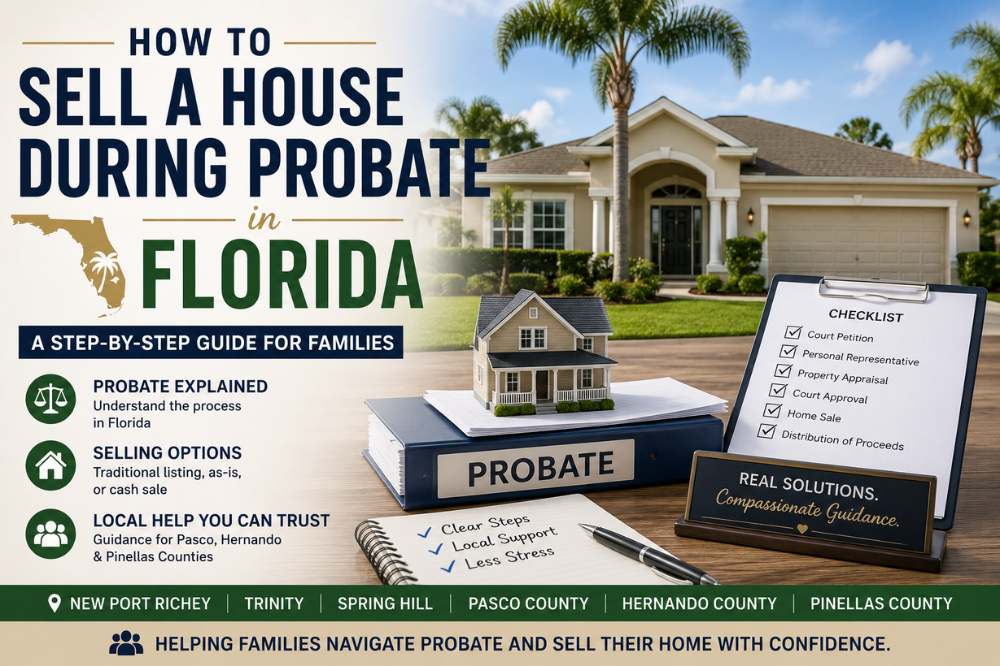
How to Sell a House During Probate in Florida
Losing someone you love is never easy. While you’re grieving, you may suddenly find yourself responsible for a house, legal paperwork, personal belongings, and decisions you never expected to make.
It’s a lot to take on.
One of the first questions families ask me is, “Can we even sell the house while it’s in probate?”
The answer is often yes.
In fact, selling the home during probate can be a practical way to simplify the estate, preserve the property’s value, and help everyone move forward.
I’ve worked with families throughout Pasco and Hernando Counties who were handling a parent’s home, an inherited property, or an estate while trying to coordinate siblings living in different states. Every situation is different, but one thing is almost always true: once you understand the process, it becomes much less intimidating.
My job isn’t to provide legal advice—that’s what your probate attorney is for. My role is helping you understand your selling options, coordinating what needs to happen with the property, and making the real estate side of the process as manageable as possible.
What Does Probate Mean When You’re Selling a House?
Probate Gives Someone Legal Authority to Handle the Estate
Probate is the legal process of settling someone’s estate after they pass away.
If the home was owned solely by the deceased, the property usually can’t be sold until someone has the legal authority to act on behalf of the estate.
That person is called the personal representative, sometimes referred to as the executor.
The personal representative may be responsible for tasks such as:
- Managing estate assets
- Working with the probate attorney
- Paying valid debts when required
- Handling the sale of the home
- Distributing proceeds according to the estate plan or Florida law
Probate is handled through the Circuit Court in the appropriate Florida county.
Although probate can sound complicated, most families I talk with are trying to answer much more practical questions:
What happens first? What should we do with the house? And how do we keep everyone on the same page?
Those are the questions I help families work through on the real estate side of the process.
Can You Sell a House During Probate in Florida?
Yes, a Probate Property Can Often Be Sold Before Probate Is Finished
In many situations, a home can be sold while probate is still underway.
Once the proper legal authority is in place, the property may be able to be:
- Listed on the MLS
- Sold as-is
- Sold to a cash buyer
- Cleaned out or prepared for a traditional sale
Although every estate is different, the process often follows a similar path:
- Probate is opened.
- A personal representative is appointed or the necessary authority is established.
- The home is evaluated.
- The family decides how the property should be prepared and sold.
- The home is listed or sold.
- Sale proceeds are handled according to the requirements of the estate.
The exact legal requirements depend on the estate, which is why I want the probate attorney involved in questions about authority, court requirements, and distribution of proceeds.
My job is to make sure the real estate side works with that process rather than creating another problem for the family.
What Happens to the House While It Is in Probate?
The Property Still Needs to Be Managed While the Legal Process Moves Forward
Many people assume probate is mostly about legal documents.
In reality, the house itself can become one of the biggest challenges.
Someone may need to check on the property, deal with belongings, arrange lawn or pool service, meet contractors, handle repairs, or simply make sure the home remains secure.
I’ve helped families where some siblings were local and others lived out of state. The home may have been lived in for decades, filled with furniture and personal belongings, and in need of repairs or updating.
The family usually isn’t asking me legal questions first.
They’re asking:
- Should we clean everything out?
- Is it worth making repairs?
- Can we sell it as-is?
- Who can meet contractors?
- How do we coordinate this when everyone lives somewhere different?
Once the person handling the estate has the authority to move forward, I can help create a practical plan for the property.
That can mean coordinating vendor access, connecting the family with cleanout or estate sale professionals, arranging contractor walkthroughs, and comparing different ways of selling the home.
The paperwork matters, but so does having someone local who can keep the property side moving.
What Type of Probate Is the Estate Going Through?
Florida Generally Uses Summary Administration or Formal Administration
The type of probate can affect how the estate is handled.
Summary Administration is a simplified probate process that may be available when the estate meets certain requirements, including situations where the estate is valued under $75,000, excluding exempt property, or the person has been deceased for more than two years.
These cases may be completed more quickly than formal probate, although timing depends on the individual estate and court.
Formal Administration is generally used for larger or more complex estates.
In formal administration, a personal representative is appointed to oversee the estate while working with the probate attorney.
Formal probate commonly takes several months, although every situation is different depending on the estate, creditors, family circumstances, and other factors.
Your probate attorney should tell you which process applies to the estate and what authority is required before making decisions about the property.
Do We Have to Empty the House Before Selling It?
No, You May Have Options for Selling a House With Belongings Still Inside
This is one of the biggest practical concerns I hear from families.
A house that has been lived in for 20, 30, or 40 years can contain an enormous amount of furniture, paperwork, clothing, tools, household items, and family belongings.
You don’t necessarily have to tackle all of it yourself before talking with me about selling.
Depending on the property and your goals, we can look at options such as an estate sale, professional cleanout, removing only certain belongings, or potentially selling the property in its current condition.
I would rather look at the house first and help you develop a plan than have your family spend weeks cleaning everything out only to discover that some of that work wasn’t necessary.
Should We Repair a Probate House or Sell It As-Is?
The Better Choice Depends on the Home, Timeline, Costs, and Family’s Goals
There isn’t one answer that works for every probate property.
Sometimes a few carefully chosen repairs can improve the home’s presentation enough to justify the time and expense.
Other times, especially when a property needs significant work, selling as-is may make more sense.
I look at factors such as:
- The home’s current condition
- The likely cost of repairs
- The family’s timeline
- Available estate funds
- The local market
- The potential return from making improvements
- How much work the family wants to manage
I don’t believe in recommending repairs simply because something looks dated.
The question is whether spending that money is likely to improve the family’s outcome.
I often help families compare the options side by side so they can make an informed decision instead of guessing.
Is a Traditional Listing or Cash Offer Better During Probate?
Both Can Make Sense Depending on What the Estate Needs
A traditional MLS listing may make sense when the home is in reasonable condition, the family has enough time, and getting broad market exposure is a priority.
A cash or as-is sale may be worth considering when the property needs substantial work, the family wants a simpler process, or speed and convenience matter more than preparing the home for the traditional market.
Neither option is automatically better.
I prefer to look at the property, understand the family’s priorities, and explain the tradeoffs.
For one estate, investing some time in preparation and listing traditionally may make sense. For another, avoiding months of cleanout, repairs, carrying costs, and coordination may be more valuable.
Education comes before the decision.
Can I Handle a Florida Probate Sale From Another State?
Much of the Real Estate Process Can Be Coordinated Remotely
Yes. This is a situation I regularly help families navigate.
If you’re handling a property in Pasco or Hernando County but live somewhere else, you may need someone local who can be your eyes and ears at the property.
I can help coordinate things such as:
- Property access
- Cleanout and estate sale companies
- Contractor appointments
- Repair estimates
- Photography and listing preparation
- Showings
- Buyer negotiations
- Inspections and appraisal access
- Remote paperwork and closing coordination when available
You don’t necessarily need to fly back to Florida every time something needs to happen at the house.
Having one local point of contact can make a complicated situation much easier to manage.
What Happens If Family Members Disagree About Selling the House?
Start With Legal Authority and Then Work Toward a Clear Real Estate Plan
Family disagreements can make probate much more stressful.
One sibling may want to sell immediately. Another may want to repair the house first. Someone else may believe the home is worth more than the market supports.
The first question is who has the legal authority to make decisions for the estate. That’s something the probate attorney should clarify.
Once that is established, I can help with the real estate questions by providing information rather than opinions based on emotion.
What is the home likely worth in its current condition? What might repairs cost? What could those repairs realistically add to the sale? How long might each option take?
Having actual information on the table can make family conversations much more productive.
What Mistakes Should Families Avoid When Selling a House During Probate?
Starting Early and Understanding Your Options Can Prevent Unnecessary Work
After helping families through estate and probate sales, I’ve noticed several mistakes that can create unnecessary stress.
Waiting too long to make a plan.
You don’t have to make every decision immediately. Starting the conversation early simply gives you more time to understand your options.
Spending money before understanding the market.
Not every inherited home needs extensive repairs or updating before it’s sold.
Cleaning everything out before evaluating the property.
Depending on how you decide to sell, you may have other options for handling the contents.
Trying to coordinate everything alone.
Attorneys, contractors, cleanout companies, estate sales, family members, buyers, and inspectors can create a lot of moving pieces.
Assuming every probate sale works the same way.
Every estate and every family is different. The right solution should be based on your circumstances, not someone else’s experience.
How Can a Realtor Help With a Probate Sale?
I Handle the Property Side While Your Attorney Handles the Legal Side
I don’t replace your probate attorney, and I don’t give legal advice.
My role is to help make the real estate portion of the process easier to understand and manage.
Depending on the situation, I may help with:
- Evaluating the home’s condition
- Developing a pricing strategy
- Coordinating cleanouts and estate sales
- Connecting you with trusted local vendors
- Arranging repairs when they make financial sense
- Keeping out-of-state family members informed
- Managing showings and negotiations
- Comparing traditional listings with cash or as-is options
- Coordinating remote paperwork and closing when needed
For many families, the most valuable thing is simply having someone local who can keep everything organized while they’re dealing with everything else that comes after losing someone.
Where Should I Start If I Need to Sell a House During Probate?
Start by Understanding Your Legal Authority and Your Selling Options
If you’re handling a probate property in Florida, you don’t need to figure everything out at once.
Your probate attorney can help you understand the legal process and who has authority to act for the estate.
From there, I can help you understand what you’re dealing with at the property and what selling options make sense.
You may decide on a traditional MLS listing.
You may decide to sell the property as-is.
A cash offer may make more sense in some circumstances.
Or you may need help with cleanout, repairs, an estate sale, or simply figuring out what should happen first.
Every seller’s situation is different. That’s why I believe the best place to start is by understanding the situation rather than assuming there is only one way to sell the home.
Once we know the condition of the property, your timeline, and what matters most to the family, we can build a plan from there.
Selling an Inherited Home?
Inheriting a home comes with a lot of decisions. Whether you’re dealing with probate, considering a cash offer, preparing the property for sale, or simply trying to understand your options, I’m here to help you navigate the process with clear, honest guidance.
Explore my complete guide to selling an inherited home →
Need a FAST Cash offer? Learn more here →
Inherited a Home?
Get a professional estimate of your property’s current market value before deciding what to do next.
Helpful Resources
- Inherited Home in Florida: What to Do First — Learn the first steps to take after inheriting a property before making any selling decisions.
- Cash vs Traditional Sale During Probate in Florida — Compare the advantages of listing on the market versus accepting a cash offer during probate.
- Estate Sales & Clean-Outs: A Guide for Families — Understand how to handle furniture, personal belongings, and estate cleanouts before selling.
- Full-Service Realtor for Estate Cleanouts & Out-of-State Home Sales — See how I help families coordinate vendors, paperwork, and property management from anywhere.
- Should You Keep or Sell an Inherited Florida Property? — Explore the financial and practical considerations before deciding what to do with an inherited home.